

Open Science (OS) is defined by European Commission as a system promoting collaboration and knowledge sharing in the research community during the stages of the research process and delivering the scientific results. It aims to share scientific resources in a better manner, boost the scientific impact, and bring research results closer to society. While the OS approach directly affects institutions and science practices, it also means that scientific data and papers should become available to every member of society without a need to be affiliated with a research organization or to pay to read an article. Thus, Open Access (OA) to scientific publications is one of OS’s branches.
Currently, OA is defined by the Finnish Ministry of Education and Culture in the Publication data collection instructions for researchers 2021 document in the following way:
- The publication can be read, printed out and copied on the Internet free of charge and in an accessible way, at least for non-commercial use.
- The publication is publicly available in a service offered by the publisher or the research organisation which enables harvesting the publication’s metadata and indexing its content for other search services and supports making references to the publication and linking it to website addresses that are based on permanent identifiers (DOI, URN, Handle).
- The publicly available version of the publication is either the final self-archived version of the publication or the final version published in the publisher’s service, depending on the publication contract or the publisher’s policy. If the publication is refereed, the open access version must also be refereed.
In Finland, Journal.fi platform was launched in 2017 by the Federation of Finnish Learned Societies. This national platform currently gathers 130 Finnish scholarly journals and uses the Open Journal system.
Publication data from universities and university hospitals has been collected by the Ministry of Education and Culture since 2011 and from Universities of Applied Sciences since 2012 (Ilva 2017). Several platforms were developed to access the publication information.
Research.fi portal presents information on research conducted in Finland with the aim to increase awareness of research and its impact on society. Currently, the service contains data on publications, Finnish research system, funded projects, information on researchers working in Finland and their research activities, and statistics on the development of research resources and impact. Research.fi collects the data through, e.g., the national VIRTA publication information service. VIRTA service started in 2016 with the aim to integrate institutional data at national level. It represents an extended data warehouse that provides up-to-date metadata to institutions and research organizations on their own publication activity.
Open access status of publications on VIRTA are classified in a similar way to Web of Science (WoS) OA categorization (Pölönen et al. 2020):
• VIRTA gold: outputs indicated as being immediately openly available in a gold OA channel where all outputs are OA
• VIRTA hybrid: outputs indicated as being immediately openly available in a hybrid OA channel, including both OA and closed outputs
• VIRTA gold and hybrid: outputs with authors from more than one Finnish university that indicated the same output differently as being immediately openly available in a gold OA or hybrid OA channel
• VIRTA green: outputs indicated as being openly available in an OA repository and are not indicated as being openly available in a gold OA or hybrid OA channel
• VIRTA closed: outputs not indicated as being openly available in a gold OA or hybrid OA channel, or an OA repository
However, there seems to be a difference in the OA coverage by VIRTA and commercial databases such as WoS and Scopus. As such, WoS and Scopus have lower coverage of Finnish peer-reviewed publications than VIRTA, especially if the publication’s language is Finnish and not English; WoS and Scopus also have lower coverage of the number of OA publications for social sciences and humanities, and books compared to journals. According to Pölönen et al. (2020) who analyzed OA coverage in comparison between national and international databases on a set of 48,177 journals, conferences, and book publications from 14 Finnish universities in 2016-2017, only 62% of these peer-reviewed papers are indexed in Scopus and 52% in WoS. From this bulk of research publications, 34 % are reported on VIRTA to have OA.
In commercial usage on the international level, WoS pioneered providing OA in 2014 and ensured better identification of OA via collaboration with the non-profit organization Impact story (Our Research). According to WoS, there are around 12 million articles in OA and 5,000 OA journals to date, and 23% of WoS journal articles published over the past five years offer free versions of articles.
WoS distinguishes OA publications into several categories: Gold (Gold and Gold Hybrid), Free to read (formerly Bronze), and Green (published, submitted, and accepted). In the Gold category, the articles can be freely read from the publisher’s website, they are published in journals listed in the Directory of Open Access Journals (DOAJ), and have a license in accordance with the Budapest Open Access Initiative. Hybrid Gold publications are not published in a DOAJ list journal but have a Creative Commons license. According to WoS, most of these articles are published in hybrid journals offering only partial OA articles. Free-to-read (Bronze) category articles are openly available on the publisher’s website for a limited period and then the access might be restricted. The Green category is divided into published, submitted, and accepted. Use and copyright are determined by institutions or subject-based repositories for Green-published works. Accepted green is manuscripts hosted on a repository, but the publisher determines content and copyediting.
The annual publication data in Finland gathered by the Ministry of Education and Culture via the above-mentioned services is presented in different statistics reports on Vipunen website. In 2022, OA indicators were added to the Vipunen bibliometric reports based on Web of Science data. Various analyses can be conducted based on this data.
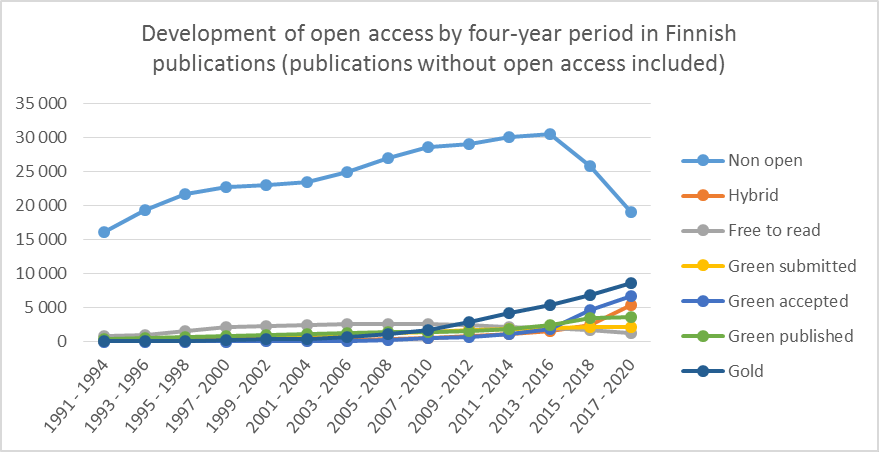
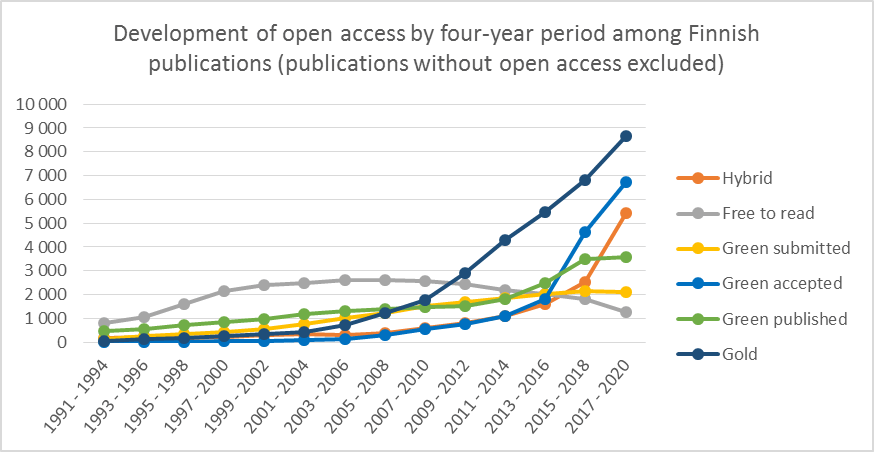
As such, almost all OA categories have been growing in the past years in the Nordic countries, the only exception is the green category. In general, the share of OA publishing in total number of publications in the Nordic countries is around 74%, higher than the world average. Among the Nordic countries, Finland leads the share of OA publications. Among Finnish publications, there is a clear decline in publications without OA after 2016. OA publications of all categories have been steadily growing with the gold category having the highest number of publications. While this is an overall trend, the report allows looking into details for a particular organization, organization segments, and certain fields of science over four-year periods.
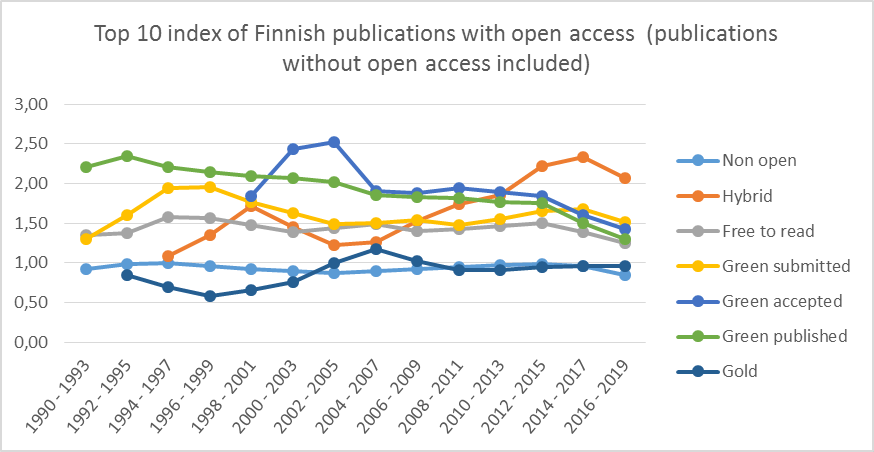
Another Vipunen report based on WoS data allows for the analysis of the Top10 index on OA publications over four-year periods. The Top10 index, which is greater than 1, indicates that a higher proportion of the publications of the organization or discipline than the world average in the same field belong to the ten most cited percent in the field. As an overall trend, the Top10 index is the lowest among papers without OA and the highest in the hybrid or in different green OA categories. These trends remain relatively stable over years. The Top10 index of hybrid OA articles has risen remarkably since 2004. The report provides an analysis of the same trends for the Top10 index among fields of science and organizations.
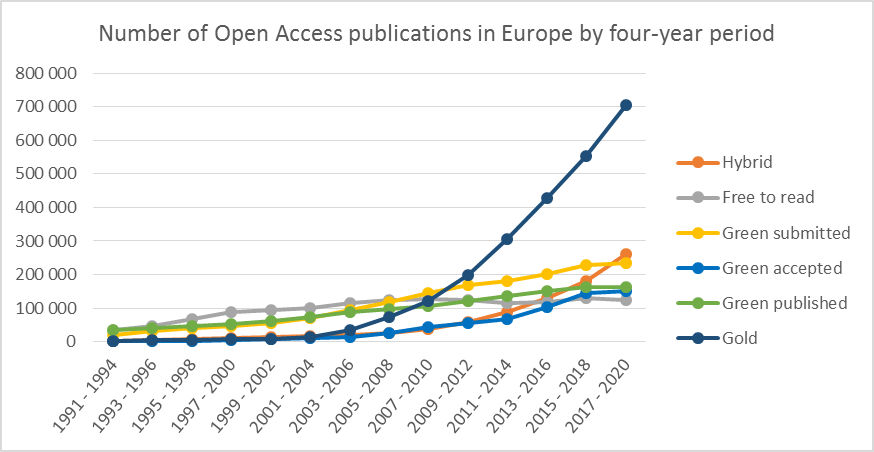
In addition, Finnish OA publications can be compared with other countries performance. On the global level, there is a growing trend of non-open publications in the last ten years. The picture differs for Europe where the trend switched to a decreasing number of publications without OA approximately in 2014. Moreover, the amount of gold-access publications is rising. The graph below illustrates a trend for Europe.
Overall, OA is an evolving direction in scientific publishing and in bibliometrics both internationally and domestically. Not all Finnish publications and publications with OA are represented on Web of Science. Wider picture on OA publishing in Finland is available based on VIRTA publication data which is represented on Research.fi and Vipunen service. Nevertheless, Vipunen’s reports on WoS publications enable analyses on volume and scientific impact of OA publishing in different countries, and illustrate that the numbers of OA publications of different categories tend to rise over the years while the numbers of non-open papers tend to decrease.
References:
Ilva, J. (2017). Towards Reliable Data – counting the Finnish Open Access Publications. Procedia Computer Science, 106: 299-304.
Pölönen, J., Laakso, M., Guns, R., Kulczycki, E. & Sivertsen, G. (2020). Open access at the national level: A comprehensive analysis of publications by Finnish researchers. Quantitative Science Studies, 1 (4): 1396–1428.
Text by Valeria Caras, edited by Otto Auranen and Laura Himanen

 Tilastoneuvos